How VTR designs robust, repeatable feeding solutions that keep automotive production lines running.
In automotive manufacturing, downtime is more than an inconvenience. It is one of the most expensive risks on the production floor.
Automotive production environments depend on tightly coordinated automation, with multiple stations, robots, and inspection systems working together in precise sequences. When one process is interrupted, the effects can cascade quickly across the line, impacting throughput, quality, delivery schedules, and overall profitability. For automotive OEMs and Tier 1 suppliers alike, maintaining uptime is not optional. It is foundational.
Automated parts feeding systems play a critical role in this equation. Feeders sit at the very front of the automation process. If parts are not delivered consistently, correctly oriented, and at the required rate, everything downstream is affected.
At VTR Feeder Solutions, we design parts feeding systems with one primary objective: keeping automotive production lines moving reliably, shift after shift and program after program. Downtime prevention is not an afterthought—it is engineered into every system we build.
The Role of Parts Feeding Systems in Automotive Production Downtime
Automotive production environments are designed for speed, consistency, and scale. Assembly lines are balanced to precise takt times, and automation is tightly integrated with robotics, vision systems, and quality controls.
When a feeder jams, misfeeds, or delivers parts inconsistently, the impact can be immediate and severe:
- Entire lines can stop within seconds
- Operators are pulled away from value-added tasks to intervene
- Downstream processes lose synchronization
- Quality risks increase with manual intervention
- Brief feeder issues can cause extended downtime due to required resets, checks, and coordinated restarts
Production volumes and process complexity make reliable parts feeding systems critical to maintaining predictable automation in modern automotive manufacturing.
Common Causes of Downtime in Automotive Parts Feeding
Downtime related to feeding systems is rarely caused by a single failure. More often, it results from design decisions that don’t fully account for real production conditions.
Inconsistent Part Presentation
Automotive components often vary slightly due to upstream manufacturing tolerances. Feeding systems that assume perfect part consistency can become unstable when variation appears.
Tooling That Is Too Aggressive or Too Passive
Overly aggressive tooling can damage parts or accelerate wear, while overly passive designs may struggle to maintain orientation at production speeds.
Poorly Controlled Part Flow
Unstable flow leads to surging, starvation, or bottlenecks, each of which increases the likelihood of misfeeds and downstream faults.
Limited Testing Before Deployment
Systems that perform well during short demonstrations may fail under continuous, multi-shift operation if they have not been properly validated.
Difficulty Replicating Systems Across Lines
When feeder designs vary from one build to the next, maintenance teams face inconsistent behavior, higher spare parts complexity, and longer recovery times.
Reducing downtime requires addressing these challenges at the design stage—not after the system is installed.
Types of Parts Feeding Systems Used in Automotive Manufacturing
Different automotive applications require different feeding strategies. At VTR, we design and integrate multiple feeder types depending on part geometry, volume requirements, and production goals.
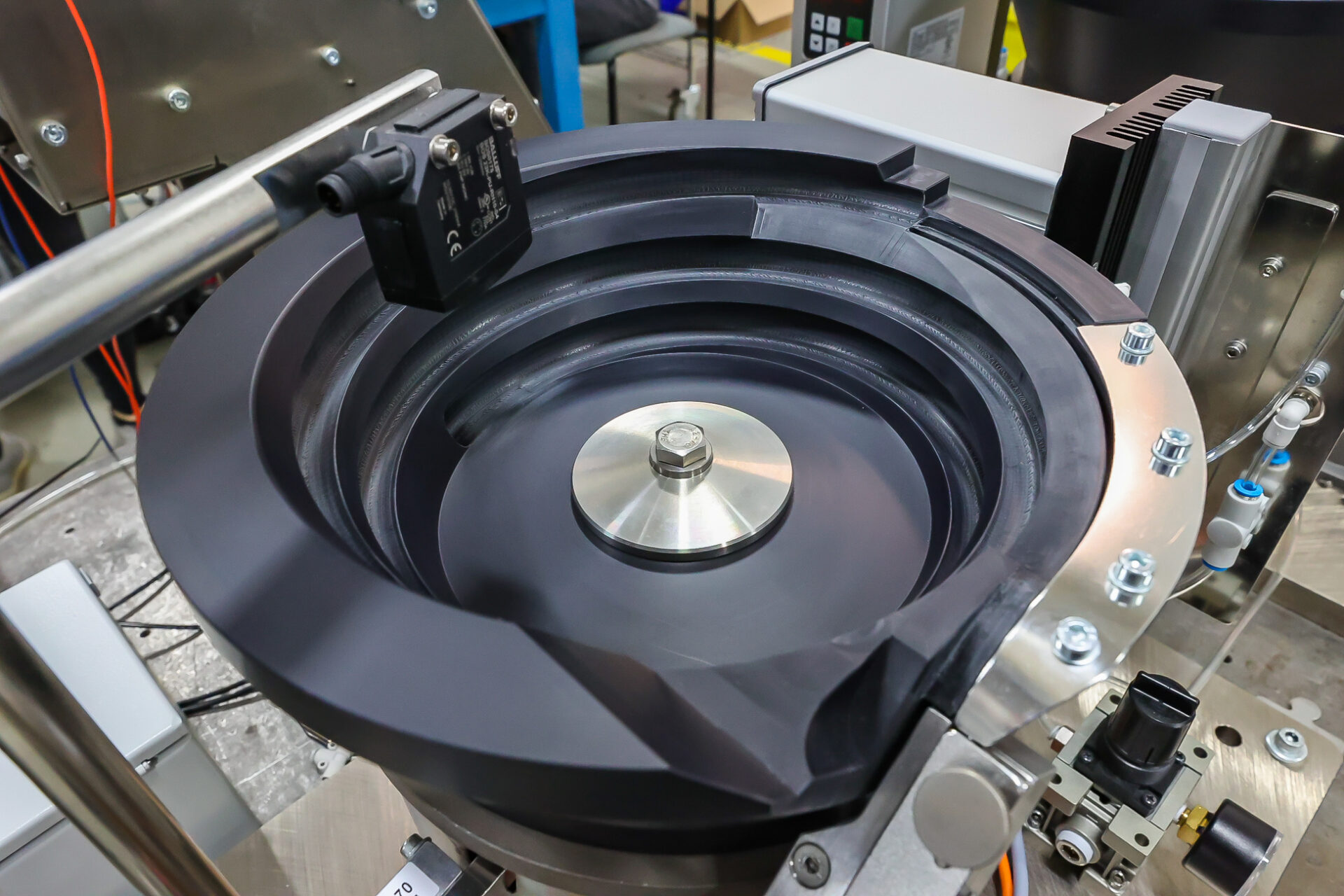
Vibratory Bowl Feeders
Bowl feeders are a cornerstone of high-volume automotive production. They are well suited for components that require consistent orientation and steady throughput.
Common automotive applications include:
- Fasteners, clips, and retainers
- Pins, bushings, and bearings
- Machined metal components
- Small plastic molded parts
VTR’s machine-fabricated bowl designs provide repeatable performance, making them ideal for programs that require duplication across multiple lines or facilities.
Linear Feeders
Linear feeders are often used to transport and buffer parts after orientation or to deliver parts to assembly, inspection, or robotic pick points.
They support automotive production by:
- Maintaining consistent spacing and flow
- Preventing vibration from interfering with downstream equipment operation
- Maintaining consistent part flow so downstream stations are neither starved nor overloaded
Linear feeders are frequently paired with bowl feeders to ensure stable, controlled delivery into the assembly process.
Robotic Flex Feeding Systems
Robotic flex feeders are increasingly used in automotive environments where part variation, mixed models, or frequent changeovers are required.
Typical applications include:
- Electrical connectors and terminals
- Plastic housings with multiple variants
- Low-to-medium volume or high-mix programs
By combining flexible feeding platforms with vision and robotics, these systems offer adaptability while still supporting reliable automation.
Standalone POKs (Point-of-Kit Feeding Systems)
Standalone POKs are used when parts need to be presented directly at the point of use without integration into a larger feeding system.
They are often applied when:
- Space is limited
- Parts must be staged near manual or semi-automated stations
- Simple, reliable presentation is preferred over high throughput
- Providing maximum flexibility, allowing manufacturers to integrate specialized feeding into existing machines or assembly processes
POKs play an important role in supporting uptime by ensuring parts are consistently available at the point of use, without disrupting existing equipment or workflows.
Automotive Components That Demand High-Reliability Feeding
VTR designs feeding systems for a wide range of automotive components, including:
- Fasteners and specialty hardware
- Clips, retainers, and push-in components
- Bushings, bearings, pins, and shafts
- Gears and machined metal parts
- Electrical terminals and connectors
- Plastic housings and molded components
- Safety-related components requiring consistent orientation
These parts must be delivered accurately and consistently, without jams, damage, or variation that could disrupt production.
How VTR Designs Parts Feeding Systems for the Automotive Industry
Reliable parts feeding is achieved by designing systems to perform predictably under real production conditions. At VTR, we engineer feeding systems with stability, repeatability, and long-term operation in mind, so they continue to perform consistently across shifts, operators, and production programs.
Our tooling is designed to tolerate normal part variation without becoming sensitive or unstable. This reduces nuisance faults, misfeeds, and unnecessary operator intervention while improving overall line confidence. Machine-fabricated feeder designs support repeatability across builds, making it easier to duplicate systems, standardize maintenance practices, and manage spare parts across multiple lines or facilities.
Controlled part flow is another critical focus. Balanced feeding and accumulation strategies prevent surging or starvation, helping downstream automation receive parts at a consistent rate. When feeding systems integrate with robotics, vision, or assembly equipment, those handoff points are engineered carefully to reduce interface-related downtime.
Before any system leaves our facility, it is rigorously tested under production-like conditions. Extended testing ensures performance is not just achievable during short demonstrations, but reliable over long run times in real operating environments.
As a result, automotive OEMs and Tier 1 suppliers working with VTR typically see downtime reduction through:
- Fewer jams and misfeeds
- Faster recovery when issues occur
- Reduced reliance on manual intervention
- More consistent performance across duplicated lines
- Greater confidence during new program launches and production ramp-ups
VTR feeding systems are built for continuous automotive production, supporting long run times, efficient maintenance, production growth, and future program changes without sacrificing reliability.
Across applications ranging from body and chassis assembly to powertrain, electrical systems, safety components, and EV programs, the objective remains the same: deliver parts reliably, consistently, and without disruption.
Why Automotive Manufacturers Trust VTR
Reducing downtime requires more than equipment—it requires experience, discipline, and an understanding of how feeding systems behave in demanding environments. Automotive manufacturers choose VTR for their reliability-focused engineering, repeatable and scalable designs, tooling that tolerates real-world variation, rigorous testing, and a collaborative, production-driven approach.
We don’t just build feeders. We design systems that protect uptime, support production goals, and help automotive manufacturers operate with confidence.
Contact VTR Feeder Solutions to discuss your parts, your process, and your production goals. Together, we can design a feeding solution that keeps your automotive lines running, consistently and reliably.