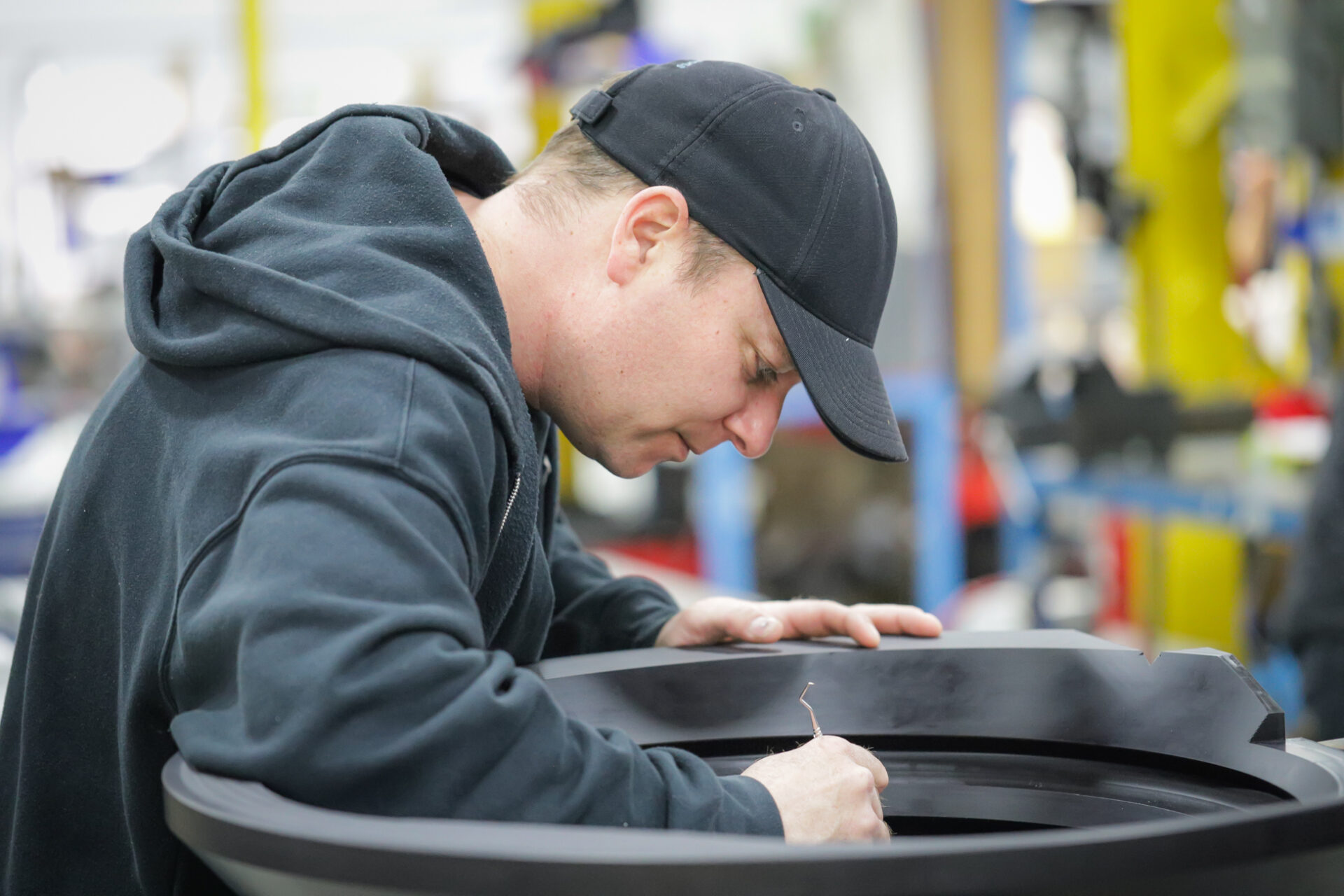
With micro components, the smallest details can determine whether a line runs smoothly or requires constant attention.
Micro parts do not behave like scaled-down versions of larger components. Because they are lightweight and compact, they are far more sensitive to vibration, friction, contact points, static, and even subtle changes in track condition. Variables that would have little effect on a larger part can significantly change how a micro component travels, orients, and arrives at the pick point.
That is what makes micro feeding so challenging. A vibration profile that moves a larger part smoothly may cause a micro component to hop, rotate, or behave inconsistently. A guide rail that simply steers a larger part can scuff or damage a delicate feature at micro scale. Even recirculation becomes more critical. When parts repeatedly re-enter the system, small impacts can accumulate over time and lead to deformation or surface damage.
Micro parts are also highly susceptible to subtle damage that may go unnoticed during the feeding process and be too small to detect with the naked eye. A light impact can nick an edge. A slight rub can leave a faint scuff on a functional surface. Because the contact area is so small, even normal part-to-part contact can create defects that are difficult to catch during feeding, but later appear as fit issues, sealing problems, or inconsistent assembly performance.
Contamination can be just as difficult to detect. Contact surfaces can generate microscopic particulates through wear. Debris may also be introduced during handling or recirculation. These issues often do not appear during setup. Instead, they show up later through rising reject rates, inconsistent inspection results, or assemblies that no longer come together reliably.
This is why micro components require feeding systems engineered around the part itself — its geometry, mass, surface finish, and the features that must be protected throughout handling. The most effective systems are designed to:
- separate parts from bulk with minimal impact
- guide orientation gently and consistently
- reduce unnecessary contact and wear
- present each part in a stable, repeatable state at the pick point
When the feeding system is matched to the component, the result is more than improved flow. It protects part integrity, reduces contamination risk, and supports a stable, repeatable process at production speed.
Defining Micro Components in Automated Feeding
In micro parts feeding automation, “micro” typically means small enough that the part’s low mass and tiny features change how it behaves in motion. These parts can be only a few millimeters long, often with features that are easy to mark, deform, or contaminate. They may also be nearly symmetrical, which makes reliable orientation harder than you’d expect.
A useful way to think about micro components is this: the part has less inertia to resist movement, and less surface area to distribute contact. That combination makes it more sensitive to vibration energy and to every point where it touches tooling, track surfaces, other parts, or recirculation paths.
Micro Component Examples and Why They’re Challenging to Feed
Across the medical devices, pharmaceutical, packaging, consumer goods, and automotive industries, micro feeding challenges usually center around a few common part families:
- Micro springs and wire forms: Tiny metal springs or bent-wire pieces that can tangle, bounce, and deform from repeated contact during feeding.
- Pins and inserts: Small precision pins that easily roll or flip in motion, and even a tiny nick can prevent proper seating.
- Stamped contacts and terminals: Thin metal pieces that can scuff or bend easily, and must arrive in a consistent orientation to function properly.
- Clips, retainers and snap features: Lightweight clips that tend to flip or nest together, and surface marking can quickly become a quality issue.
- Seals and elastomer rings: Tiny rubber-like seals that can attract debris, pick up particulate, or get marked, even with gentle handling.
These categories cover many micro component feeding projects because they share the same core constraints: low mass, tight tolerances, sensitive features, and a narrow process window where vibration, friction, and tooling contact can quickly push parts into damage, contamination, or unstable orientation.
Challenges in Automated Feeding for Micro Components
In micro feeding, the most common challenges are protecting delicate features, holding orientation consistently, and keeping the process clean and repeatable at speed. These factors are closely connected. Too much contact can scuff or deform a part. Too much energy can make parts hop, roll, or drift out of place. And as surfaces wear over time, microscopic particulate can enter the process.
In production, you don’t always see the issue at the feeder first. More often, you see it downstream in the form of missed picks, intermittent stoppages, rising reject rates, or assemblies that stop coming together consistently over long runs.
When feeding isn’t engineered properly, problems usually show up in a few predictable patterns:
Micro Damage That Shows Up Later
- Nicks on edges or corners from repeated micro impacts
- Subtle scuffs on functional surfaces from friction
- Bent or relaxed formed features, especially on thin metal parts
- Gradual deformation over time due to recirculation and re-contact
Micro damage is frustrating because it often hides during setup and only reveals itself under production conditions. Parts may pass a quick visual check, but a tiny nick, scuff, or slight deformation can surface later as intermittent fit issues, inconsistent engagement, or assembly failures once the line is running at speed.
Orientation Instability and Inconsistent Picking
- Parts that hop, rotate, or shift out of position
- Doubles or uneven spacing that leads to missed picks and timing issues
- Orientation that holds during setup and testing, but becomes inconsistent over long runs at full speed
- Inconsistent picking that force resets, slowdowns, and operator intervention
When orientation and spacing aren’t consistent, picking becomes unreliable. Cycle time becomes unstable, manual interventions increase, and overall line stability breaks down.
Contamination and Particulate Risk
- Wear on tooling and track surfaces can generate microscopic particles over time.
- Debris can be introduced during handling and refills, including packaging dust, fibers, or small fragments.
- Static can attract and hold airborne dust on parts and tooling, allowing buildup during long runs.
- When parts recirculate back through the feeder, they can rub against surfaces repeatedly, increasing wear and contamination over time.
Contamination issues often show up only after the line has been running for a while. They can look invisible at startup, then surface hours or days later as reject rates climb, inspection results become inconsistent, and assemblies stop coming together as seamlessly as they should.
How Micro Feeding Problems Show Up Downstream
This is where micro feeding problems get expensive, because the symptoms don’t always show up during the feeding process, but the effects appear later downstream.
- Fit and assembly issues: parts don’t fit together seamlessly, sealing surfaces don’t mate properly, or engagement becomes inconsistent.
- Scrap and rework: reject rates increase, and more assemblies need to be reworked or scrapped.
- Slowdowns and stops: missed picks and assembly interruptions lead to resets, operator intervention, and lost throughput.
- Longer troubleshooting cycles: the problem looks like an assembly or inspection issue, so teams spend time debugging downstream before tracing it back to feeding.
Micro feeding issues can be hard to spot early because parts may look fine at a glance. The impact shows up later, when small inconsistencies turn into real production problems.
Separation and Motion Control for Micro Components
Micro component feeding is most effective when the system is designed around the part, not forced into a generic feeding approach. The goal is to control how the part moves, how it’s guided into orientation, and how it’s presented so it arrives at the pick point in a consistent, usable state.
Why Vibration Needs a Different Approach at Micro Scale
Vibration is one of the most effective tools in micro parts feeding automation, but it has to be controlled carefully. At micro scale, the right vibration level is critical so parts move reliably without hopping, tumbling, or repeatedly contacting each other.
Where Most Issues Start: Bulk Separation
A lot of micro feeding issues start in bulk. Lightweight parts can bridge, nest, or cling together, then release in bursts that crowd the track and create collisions. A precision approach focuses on steady, controlled flow from the start, with smooth transitions that help parts separate cleanly before orientation is attempted.
What Good Separation Looks Like:
- A steady, controlled flow instead of bursts
- Clean singulation with minimal part-to-part contact
- Smooth transitions that prevent crowding and collisions
Vibration Tuning That Keeps Parts Predictable
Micro components typically need controlled sliding and stable tracking, not bouncing or hopping. That means keeping transitions between zones gentle and reducing vibration near the pick point so parts arrive stable and settled. Track and tooling geometry should reinforce the part’s most stable orientation so the system naturally favors the correct pose.
Feeding Systems for Micro Part Automation
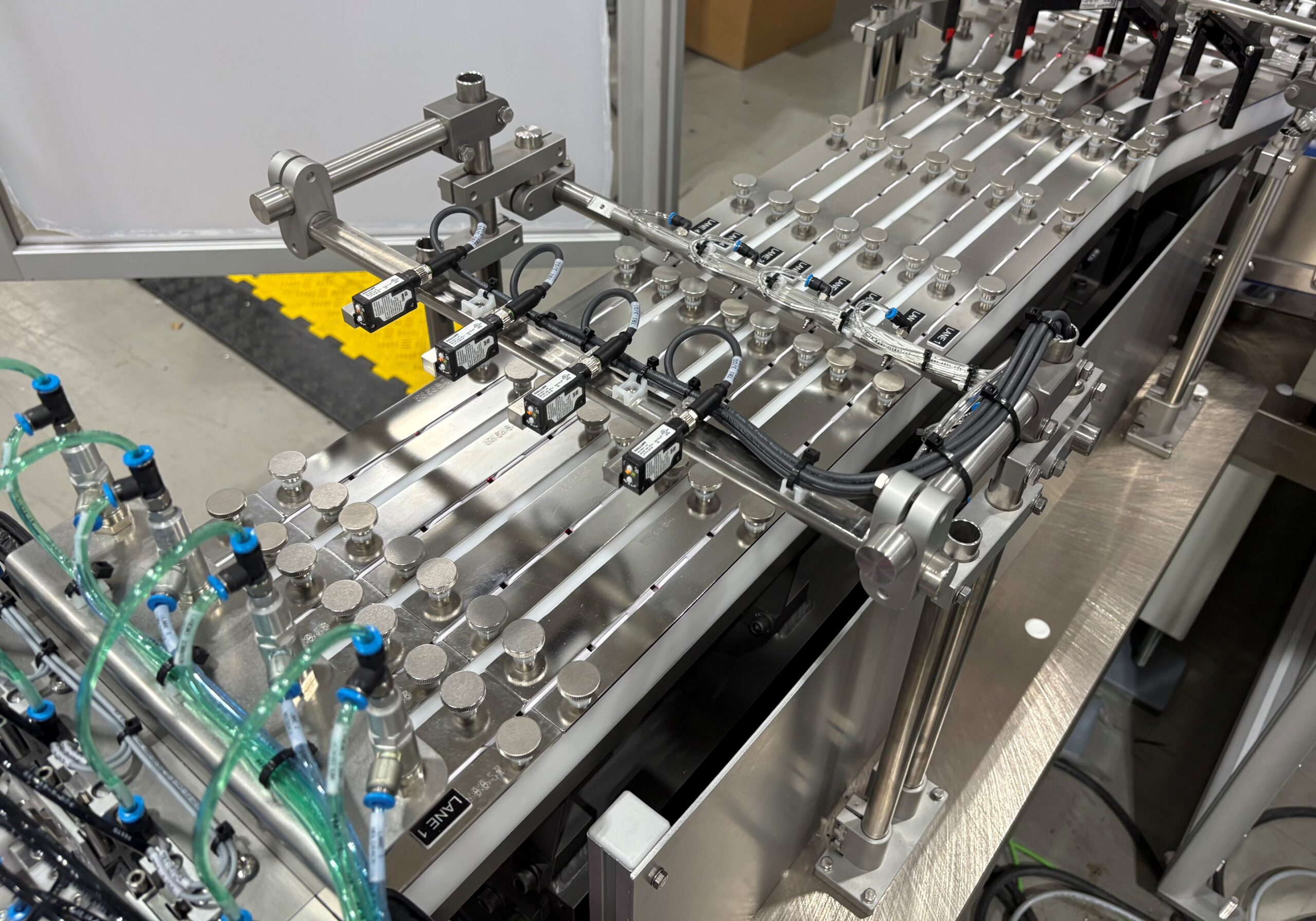
In many applications, a vibratory bowl feeder is used to singulate and orient parts, then a linear track stabilizes flow and delivers consistent presentation at the pick point. When more flexibility is required for part changeovers, when multiple variants must run on one system, or when mechanical orientation isn’t reliable enough on its own, a vision-guided robotic flex feeder may be a better fit.
Controlled Recirculation for Micro Parts
If parts recirculate back through the system, the return path needs to be controlled. Repeated re-entry with small impacts can slowly deform delicate features over time. A micro feeder design treats recirculation as a gentle, guided return, not a drop back into bulk, so parts return predictably without accumulating damage.
Vision-Assisted Feeding for Micro Components
Mechanical orientation can take you far, especially with well-designed vibratory bowl feeders and linear feeders. But some micro parts push beyond what mechanical tooling can guarantee at high confidence, particularly when:
- features are tiny or near-symmetrical
- pose matters tightly for downstream insertion
- the part varies slightly between batches
- the line needs flexibility or frequent changeovers
This is where robotic flex feeding becomes a strong fit. Vision can either verify orientation or enable more flexible picking, depending on what the application needs. One common approach is mechanical orientation with vision verification, where the feeder does the heavy lifting by separating parts and guiding them into a likely orientation, and vision confirms the part’s pose before the pick so incorrect orientations (or doubles) can be rejected early.
When mechanical orientation reaches its limits, vision-assisted flex feeding provides the verification and changeover flexibility needed to keep micro parts picking reliably at production speed.
Work with VTR Feeder Solutions
When micro components are involved, feeding reliability is often the difference between stable production and constant troubleshooting. If you’re seeing intermittent jams, missed picks, rising reject rates, subtle scuffing, or contamination concerns that are hard to trace, the feeding process may be the place to look.
VTR Feeder Solutions specializes in micro-part feeding automation, designing precision systems around the part’s geometry, mass, and critical features to protect part integrity and keep performance stable at production speed. Whether the right solution is a vibratory bowl feeder, a linear feeder/track, or a vision-guided robotic flex feeder, VTR helps you choose the best approach and engineer it for reliable separation, consistent orientation, and repeatable presentation.
Contact VTR Feeder Solutions to discuss your component and build a feeding strategy you can trust in production.