
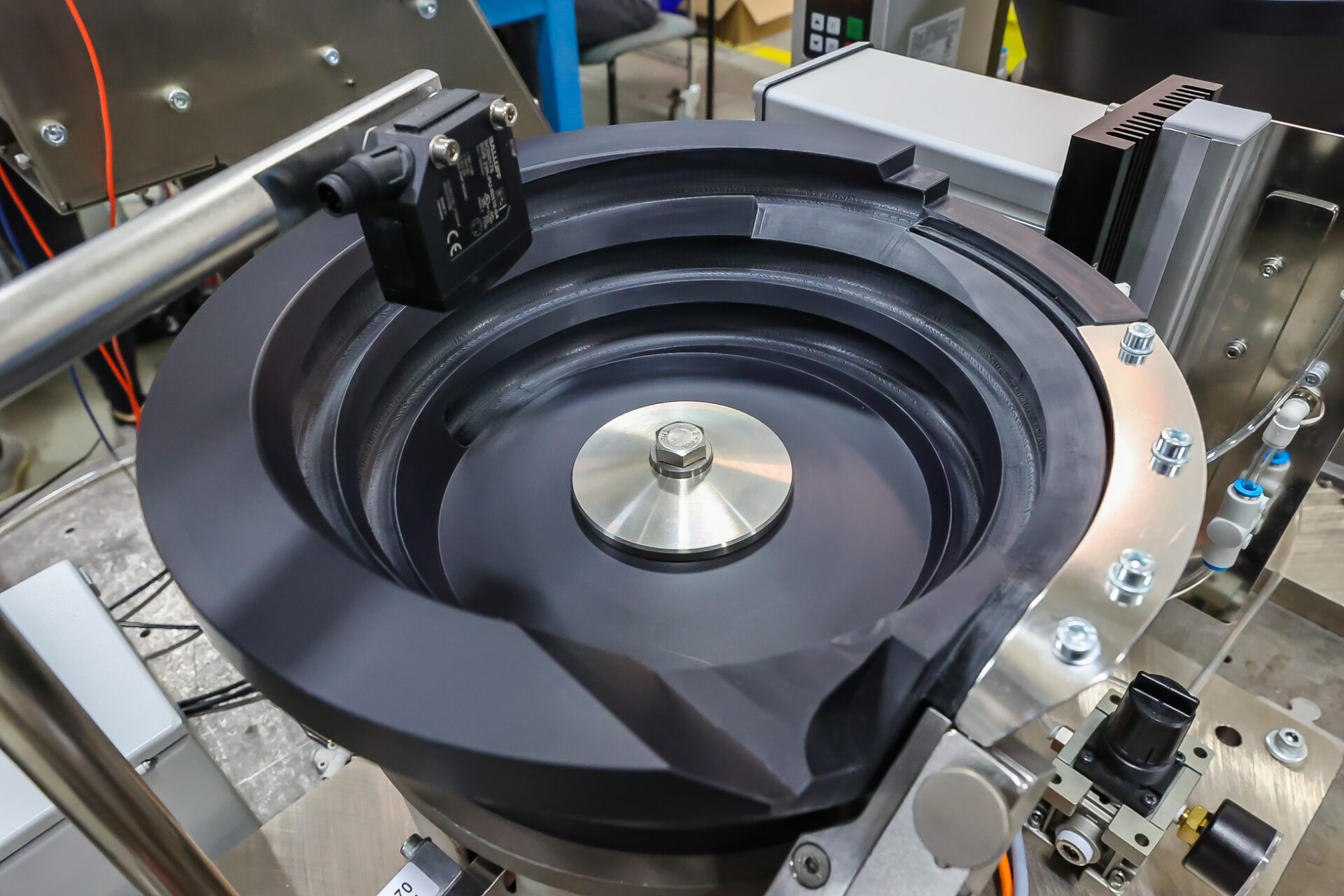
Vibratory feeding systems are built to move parts efficiently, consistently, and accurately. In many automated production environments, they are one of the most dependable ways to orient and deliver components into assembly, inspection, packaging, or processing equipment.
Because these systems rely on controlled vibration and repeated part movement, noise can become an important topic of conversation.
In some applications, the sound is minimal. In others, especially when metal components, high feed rates, multiple bowls, or operator-adjacent workstations are involved, feeder noise can quickly become a bigger concern. It can affect communication on the floor, operator comfort, concentration, and the overall working environment around the automation cell.
For manufacturers, this makes noise reduction more than a comfort issue. Around the world, many workplace safety frameworks use an 8-hour exposure benchmark around 85 dBA as a common reference point for managing hazardous noise in manufacturing environments.
The good news is that feeder noise is not simply something manufacturers have to accept. With the right design decisions, materials, coatings, mounting strategy, and guarding approach, a vibratory feeding system can often be made quieter while still maintaining reliable feeding performance.
Why Vibratory Feeders Create Noise
Before noise can be reduced, it helps to understand where it comes from. In a vibratory bowl feeder, controlled vibration moves parts along a custom track, where they are gradually separated, oriented, and presented for the next stage of production.
Noise can come from several areas of the system:
- Parts contacting the bowl surface
- Parts colliding with each other
- Vibration transferring into the machine frame
- Metal-to-metal contact points
- Loose components, covers, or guarding
- Air blow-offs or escapements
- The natural sound of the drive unit and tooling
The amount of noise depends heavily on the part being fed. Small plastic components may be relatively quiet. Larger metal parts, sharp-edged components, springs, clips, caps, or stamped parts can create much more sound as they move through the bowl.
That is why noise reduction should be considered as part of the feeder design process, not as an afterthought once the system is on the production floor.
Noise Control Starts With Feeder Design
Quieter feeding starts with better feeder design.
When a bowl is designed properly, parts move in a controlled and predictable way. They do not bounce excessively, pile up in problem areas, or repeatedly collide with hard tooling surfaces. A smooth feed path reduces unnecessary impact, which helps reduce sound.
Vibratory feeder design choices that can help manage noise include:
- Wider or more controlled tracks where appropriate
- Gentle transitions between tooling sections
- Proper part recirculation paths
- Reduced drop heights between sections
- Tooling that minimizes aggressive rejection points
- Correct bowl size for the part and required feed rate
- Controlled part volume inside the bowl
A feeder that is undersized or pushed too hard may become noisier because parts are forced to move faster, collide more often, or build up in areas of the bowl. In contrast, a properly sized feeder can often run at a steadier amplitude and deliver the required rate with less mechanical stress and less noise.
This is where experience matters. A quieter feeder is not just a feeder with extra soundproofing added around it. It starts with understanding the part, the required orientation, the feed rate, and the way the component behaves under vibration.
Choose the Right Bowl Material
The material of the feeder bowl can also have a significant impact on noise.
Stainless steel is commonly used in vibratory feeding systems because it is durable, cleanable, and suitable for many industrial environments. However, when hard metal parts move across a hard metal bowl surface, the result can be a louder system, especially if the parts are heavy, sharp-edged, or being fed at higher speeds.
In some applications, the bowl material or contact surface can be adjusted to help reduce sound. The goal is to create the right balance between durability, part control, cleanability, and noise reduction. A softer or lined surface may help absorb impact, while a harder surface may be required for long-term wear resistance or strict cleaning requirements.
The best choice depends on the part being fed and the environment around the system. Medical device, pharmaceutical, automotive, electronics, packaging, and general industrial applications can all have different priorities. Some require very clean, low-particle surfaces. Others need maximum durability. Some are focused on protecting delicate parts from scratches or cosmetic damage.
Noise reduction is important, but it has to work with the full requirements of the application.
Use Coatings to Reduce Part Impact
Bowl coatings are one of the most common ways to reduce vibratory feeder noise.
A coating creates a buffer between the part and the bowl surface. Instead of parts repeatedly contacting bare metal, they move across a surface that can help dampen impact, reduce vibration noise, and protect the part during feeding.
Coatings can be especially useful when feeding metal components, cosmetic parts, delicate components, or products that are prone to scratching. In addition to noise reduction, the right coating may also improve grip, reduce bounce, and help parts move more consistently through difficult areas of the bowl.
However, coatings need to be selected carefully. A coating that is too soft may wear quickly. A coating that creates too much friction may slow down the feed rate. A coating that is not suited for the environment may create cleaning, durability, or contamination concerns.
The right coating should support the feeding process, not restrict it. It should reduce sound while still allowing the part to move, orient, and discharge reliably.
Control Vibration Transfer With Isolation Mounts
Not all feeder noise comes directly from the bowl.
In many systems, vibration can transfer from the feeder into the machine frame, table, guarding, or nearby equipment. When that happens, the surrounding structure can amplify sound. A feeder that may not be overly loud on its own can become much noisier when mounted to a surface that resonates.
Isolation mounts help reduce this transfer. They create separation between the feeder and the supporting structure, helping keep the vibration contained within the feeding system rather than allowing it to travel through the entire machine.
This can help reduce structure-borne noise, rattling panels, vibration in the frame, and unwanted movement around the automation cell. It can also improve the overall feel of the system for operators working nearby.
Mounting strategy becomes even more important when several feeders are installed on the same platform. Without proper isolation, vibration from one feeder can affect another, or multiple vibration sources can combine and create a louder working environment.
For isolation mounts to work properly, the full system needs to be considered, including the feeder, machine base, and production environment. The goal is to reduce vibration transfer without affecting feeder stability or performance.
Consider Acoustic Enclosures
When feeder design, coatings, and isolation are not enough on their own, acoustic enclosures can provide an additional layer of noise control.
An acoustic enclosure surrounds the feeder and helps contain sound within the system. This can be especially helpful when operators work close to the equipment, when multiple bowls are running in the same area, or when the feeder is located in a production space where communication and comfort are important.
A well-designed enclosure should reduce sound without making the feeder harder to use. Operators still need to see the bowl, load parts, clear jams, perform changeovers, and complete routine maintenance. If the enclosure makes those tasks difficult, it can create new problems for the production team.
The best acoustic enclosure designs consider access, visibility, cleaning, airflow, safety, and integration with the larger machine. Doors, panels, windows, and removable sections should be planned around the way the feeder will actually be used on the floor.
In other words, an enclosure should not feel like an obstacle. It should feel like part of the system.
Review Air, Escapements, and Downstream Devices
Sometimes the loudest part of a feeding system is not the bowl itself.
Air blow-offs, escapements, reject stations, part transfer points, and downstream handling devices can all contribute to overall noise. In some cases, once the bowl noise is reduced, these supporting devices become more noticeable.
Compressed air is a common example. It can be useful for part separation, rejection, or positioning, but it can also create sharp, high-frequency sound. Where possible, air use should be optimized so the system uses only what is needed. Mufflers, better nozzle placement, lower pressure, or mechanical alternatives may help reduce sound without affecting function.
The same applies to part drops and transfer points. If parts are falling onto hard surfaces, striking escapement tooling, or collecting aggressively at discharge points, those impacts can add up. Small adjustments to the transfer design can often improve both noise levels and part handling.
This is why noise reduction should be viewed across the full feeding process, not just the bowl.
Designing Quieter Feeding Systems for Real Production Environments
Every production environment is different, which means noise reduction should never be treated as a one-size-fits-all solution.
A feeder used in a high-speed automotive line may have different noise concerns than one used in a cleanroom, medical device facility, electronics assembly area, or packaging operation. Operator proximity, shift length, part material, cleaning requirements, required feed rate, and available floor space can all influence the best approach.
That is why noise should be discussed early in the feeder design process. If sound levels are a concern, it is much easier to plan for them before the system is built, tested, and installed.
Feeder design, bowl material, coatings, isolation mounts, and acoustic enclosures all play a role. The key is understanding where the noise is coming from and choosing solutions that support both sound reduction and feeding reliability.
At VTR Feeder Solutions, we look at vibratory feeding systems as part of the larger automation environment. A feeder has to do more than move parts. It has to support the people, equipment, operators, and production goals around it.
A quieter feeder is not just more comfortable to work around. It is often a sign of a more controlled, better-integrated system.
For manufacturers planning a new vibratory feeding system, noise reduction is worth discussing early. The right decisions at the design stage can lead to smoother operation, improved operator experience, and dependable feeding performance over the long term.
VTR Feeder Solutions Inc.
Serving Canada, United States, Europe and everywhere in between.
Request a Quote


